Why German-Made Restraints Keep Winning My Tests: A Closer Look at KlinikBondage
I've spent the better part of four years buying, testing and quietly retiring bondage gear. Most of it doesn't survive the year. Rope frays, leather sours, chrome bites, and the marketplace stuff falls apart somewhere between the second and third use. So when a brand keeps coming up in comparison threads and keeps outlasting everything else on my shelf, it's worth writing about. KlinikBondage is that brand — a small German manufacturer that has built its entire catalogue around one unfashionable idea: that restraints should be treated as engineered equipment rather than novelty items. This isn't a sponsored piece. It's the result of putting their gear next to the alternatives and seeing what actually holds up.
The material problem nobody talks about
Start with what most gear is made of, because that's where the failures begin.
Leather is the genre's default, and it's the one I've grown most sceptical of. It looks the part, it ages attractively, and it is fundamentally unhygienic in this application. Leather absorbs sweat and body oils, and it cannot be machine-washed without destroying it. Anything worn against skin for an hour, repeatedly, over months, eventually smells like it. Add dyes and tanning residues and you have a genuine irritation risk for anyone with sensitive skin. Maintenance is constant, and most owners don't keep up with it.
Metal is worse in a different way. Steel cuffs concentrate load on a narrow band of skin, and the wrist is a bad place to concentrate load — it's where the ulnar and radial nerves sit closest to the surface. The classic “just use handcuffs” advice ignores that police cuffs are designed for control over minutes, not comfort over an evening. They also introduce a key dependency: a small metal object that must be findable, instantly, in low light, under stress.
Cheap plastic and injection-moulded hardware barely deserves the paragraph. It snaps, it's a poor skin contact, and it looks like what it is.
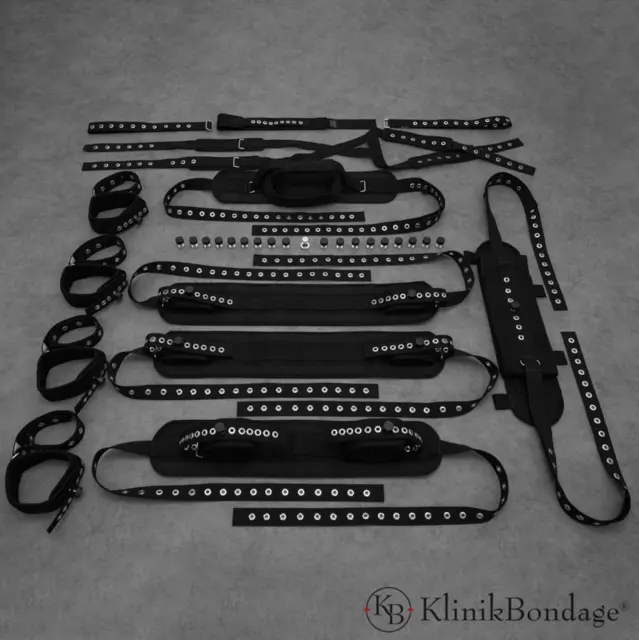
Against that, KlinikBondage's approach is almost boring. Their restraints are woven from a washable cotton-nylon yarn, with soft organic fleece padding at the joints — the cuff interior, the neck, anywhere the strap crosses a pressure point. The practical consequence is that the gear goes in the washing machine. That single fact changes the ownership experience more than any feature on any spec sheet. Breathable, hypoallergenic, padded, and washable is a combination the leather and steel camps simply cannot offer.
The closure system is the real differentiator
The part that surprised me most was the magnetic locking mechanism. I approached it with suspicion — “magnetic” in this category usually means a weak novelty catch that pops under load.
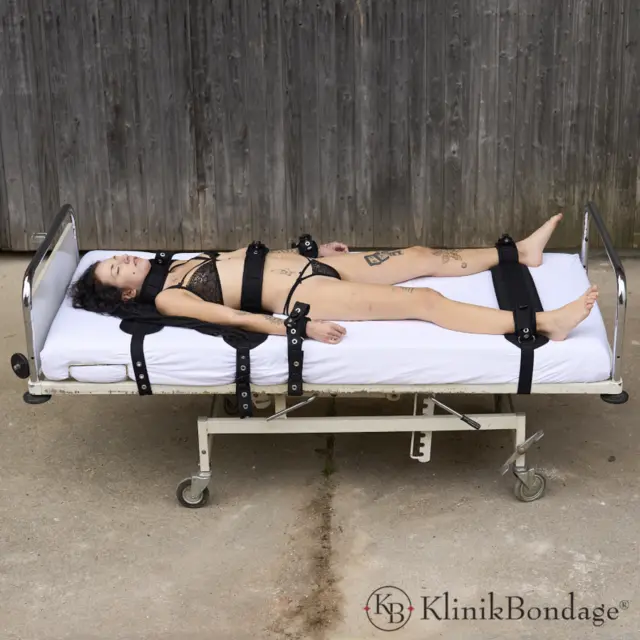
It isn't that. KlinikBondage's proprietary locks are escape-proof under deliberate pulling but release instantly with the correct key, and the interaction is a single motion rather than a fumble. In testing, that matters in two directions. Going on, it removes the setup ritual: no knots, no threading, no five-minute assembly while the mood evaporates. Coming off, it removes the failure mode that keeps safety-minded people awake — the moment where something needs to come off right now and you're working a tiny keyway by feel.
For comparison: buckles and D-rings need two hands and a sightline. Rope needs shears within arm's reach and a plan. Padlocks need the key you were holding a minute ago. The magnetic system collapses all of that into one deliberate action. It's the closest thing to a genuine engineering innovation I've encountered in this space, and it's the reason the gear gets used rather than admired in a drawer.
Where rope purists will disagree
I want to be fair here, because I like rope. Shibari is a genuine craft with an aesthetic that no strap system replicates, and there is real satisfaction in the skill.
But it is a skill, and the learning curve is not decorative — it's a safety curve. Nerve compression from a badly placed wrap can cause numbness that lasts weeks. Circulation checks are the practitioner's responsibility, and a beginner working from a video does not reliably know what they're checking for. Rope is also slow, which is fine when the process is the point and frustrating when it isn't.
The padded-strap approach sidesteps the problem rather than solving it: broad load distribution means the pressure-point maths mostly takes care of itself, and no technical knowledge is required to get it right. Not a replacement for rope. A different, considerably more forgiving tool.
Modularity, and the bed problem
A quiet strength worth mentioning: the bed sets are modular. Extension straps and additional fixtures mean the same system adapts to a box spring, a slatted frame, a futon or a bed with no usable posts at all — the scenario that renders most off-the-shelf “bed restraint kits” useless the moment they're unboxed. You buy into a system rather than a single-configuration product.
The honest caveats
It is not cheap. Bed sets run roughly €86–€160, complete systems climb past €400, and specialist pieces like straitjackets sit in the €200–€280 range. Against a €25 marketplace kit, that's a hard sell on paper — until you count how many €25 kits you've replaced.
Handmade production also means the catalogue moves at a human pace, and shipping originates in Germany, so buyers elsewhere should factor in transit. Free shipping kicks in from €149, packaging is genuinely discreet, and there's a 14-day return window.
The verdict
I've tested a lot of gear that photographs better than it performs. KlinikBondage is the inverse: unglamorous material choices, one properly clever mechanism, and construction that assumes you'll actually use the thing. If you're replacing your third cheap set this year, stop — buy once instead.