
Every Route Fans Use to Find OnlyFans Creators, and What Each One Is Actually Good For
The platform hosts more than four million creators and gives you no way to browse them. This is the map people actually use.
The single most valuable search term pointing at OnlyFans is the word "OnlyFans."
According to Semrush's keyword data for the domain, the query "onlyfans" carries around 9.1 million monthly searches and accounts for roughly 41% of the site's organic search traffic on its own. The rest of the top five are variations on the same idea: "only fans," "onlyfans app," "onlyfan," "onlyfans.com." Every one of them is what search engineers call a navigational query — someone typing a brand name to reach a front door, not describing what they are looking for once inside.
That is the whole problem in one data point. The platform lists 4.63 million creator accounts against 377.5 million registered fan accounts — roughly 81 fans for every creator — and offers no category browsing, no location filter, no recommendation feed. Its internal search works if you already have a username. It does very little if you don't.
So discovery happens somewhere else. Here is where, and what each route is honestly good for.
One note on what this map leaves out. It covers routes to creators who want to be found. Sites trading in stolen content, and services built to identify a specific person against their wishes, are not discovery mechanisms — one is theft and the other is surveillance. Neither appears below.
The platform's own search
Good for: confirming an account you already have a name for.
Not good for: anything else. Typing a real name usually fails, because most creators work under a pseudonym with no obvious link to their legal identity. There is no browse-by-category view and no trending surface. This is a deliberate architecture rather than an oversight — a platform built around creators who often need privacy is not going to expose them in a public index by default.
Treat it as a verification tool, not a search engine.
X, and the rest of social
Good for: following creators who already have an audience.
X is the only major social platform where a creator can post adult material and link straight to a paid page without workarounds. That makes it the default social home for the category, and it shows up in the data: Similarweb's audience-overlap analysis puts x.com among the five sites most similar to onlyfans.com by shared visitors.
Instagram and TikTok are a different proposition. Both restrict adult content and both throttle the links creators need, so what you see there is a sanitised version pointing at an intermediary page. You can find people this way, but the algorithm decides who surfaces, and it is not optimising for your preferences.
Good for volume. Bad for specificity.
Good for: niche interests, and reading what other people think before you pay.
Reddit's structure happens to solve what the platform doesn't: interest-based communities where adult content is permitted and where the sorting is done by people rather than an opaque feed. If your interest is specific, a relevant community will surface names that no algorithm would have handed you.
The trade-off is signal-to-noise. Promotional communities are saturated by design, and the same handful of accounts recirculate. The discussion communities are more useful than the promotional ones, which is the reverse of what most people assume.
Link-in-bio pages
Good for: getting from a social profile to the actual page.
This route is invisible until you look at the traffic data, where it turns out to be structural. Similarweb ranks linktr.ee as the fourth most similar site to onlyfans.com by audience overlap — ahead of most adult platforms. An enormous share of fans reach a creator by way of an intermediary landing page, because that is the only mechanism the restrictive platforms permit.
It is a routing layer, not a discovery layer. It gets you to a destination you had already chosen.
Directories and indexes
Good for: the case the platform ignores entirely — when you know what you want but not who provides it.
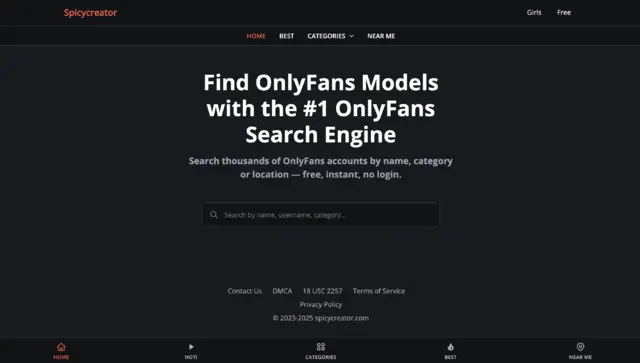
This is the gap the navigational-query data exposes. Search engines send people to the front door because there is nothing else to send them to; there is no query that means "creator in this category, in this price range, in this country" that the platform itself can answer. Independent indexes fill that in from outside, sorting public profile information into something you can actually filter. SpicyCreator is one of them, organising profiles by category, niche and location.
The caveat worth knowing: these indexes are built on publicly visible profile data, which means their coverage skews toward creators who are already active and discoverable. The long tail of quiet accounts is under-represented everywhere, including here.
A rival that built the missing function
Good for: understanding that the absence is a choice.
Fansly is, by Similarweb's reckoning, the site most similar to OnlyFans by audience — and it ships native category and tag browsing. The same fans, the same content categories, one platform with internal discovery and one without. Whatever the reasoning behind the omission, it is not a technical constraint.
What the map actually says
Put the routes side by side and a pattern emerges. Every one of them is external. Every one of them was built by someone other than the platform collecting the subscription revenue.
There is a second tell in the traffic data: Similarweb's behavioural figures show that after visiting onlyfans.com, the next destinations users most often land on are Google and X. People do not arrive, browse, and stay. They arrive, fail to find, and leave to look elsewhere — which is precisely what an 81-to-1 fan-to-creator ratio with no browse function would predict.
For a fan, the practical consequence is that no single route works. Social gets you volume, communities get you specificity, indexes get you filters, and the platform itself gets you confirmation once you already have a name. Anyone relying on one of the four is seeing a small slice of four and a half million people.
The platform, meanwhile, is under no obvious pressure to change this. It has been profitable for years without a discovery surface, and the cost of not having one falls on creators nobody finds and fans who give up looking — neither of whom shows up as a line item.


